Velutha’s arrest and death
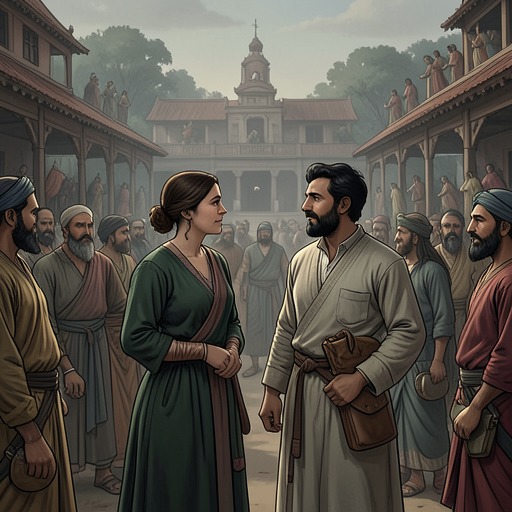
The God of Small ThingsVelutha’s arrest and death are the lethal culmination of a false accusation and a struggle over who has the authority to define what happened. The police find him before Sophie Mol’s funeral; later, Ammu goes to the Kottayam Police Station to correct the account and ask to see him, but the institution has already acted on Baby Kochamma’s version. The event’s force lies not only in Velutha’s death but in the machinery that makes it possible: caste prejudice, family reputation, police power, and Estha’s coerced confirmation of Velutha’s identity.
Causes and competing accounts
After Sophie Mol’s drowning, Baby Kochamma tells Inspector Thomas Mathew that Velutha, a Paravan factory worker, had tried to force himself on Ammu. Her allegation reverses the truth of Ammu and Velutha’s relationship. Baby Kochamma presents the charge as an explanation for the children’s disappearance and the family’s crisis, but the account is shaped by her desire to contain scandal and protect the family’s standing. As she repeats it, she begins to believe the story she has constructed.
Baby Kochamma draws on her family’s history with Velutha to make the accusation persuasive to the police. She says that her family educated him, trained him as a carpenter, and gave his grandfather a house, framing his life as a debt owed to the family. Inspector Thomas Mathew’s reply makes that paternalistic logic explicit: in his view, the family had elevated people like Velutha and was now seeking police help because they had misbehaved. The exchange treats caste hierarchy as a natural order, while the false allegation supplies a pretext for state action.
The police response is also shaped by local political calculation. Inspector Thomas Mathew summons Comrade K. N. M. Pillai to learn whether Velutha has political protection. Pillai admits knowing him but withholds that Velutha belongs to the Communist Party and had sought his help the previous night. He does not refute the false allegation; instead, he assures the inspector that Velutha is on his own. The two men do not trust each other, yet their brief conversation aligns their separate interests and leaves Velutha without support.
Arrest and death
The police find Velutha before Sophie Mol’s funeral. The account marks his arrest through the handcuffs touching his skin, while the narrative moves between this discovery and the other events unfolding around the children and their family. That timing places the arrest inside a larger crisis: the family’s grief and fear are not separate from the process by which the accusation is turned into police action.
The book later discloses the consequence through Estha’s memory. He remembers the face of a young man with an old man’s mouth, and remembers answering yes when asked whether it was Velutha. The brief confirmation is decisive: Estha’s coerced identification helps establish the police version, even though the reader understands that this version began as Baby Kochamma’s false accusation. The text connects the arrest to Velutha’s death without presenting the police action as a neutral search for truth.
Ammu’s attempt to correct the record
After the funeral, Ammu takes the twins back to the Kottayam Police Station, a place they had already spent much of the previous day. She asks to see the Station House Officer, tells him that a terrible mistake has been made, requests to make a statement, and asks to see Velutha. Her visit directly challenges the account that has authorized the police response.
Inspector Thomas Mathew refuses to treat her request as a credible correction. He tells her it is too late and that the police already know what they need to know. He uses a degrading sexual slur against Ammu and her children, reducing her testimony to her status as a divorced woman and a mother of children he calls illegitimate. His response reveals that the station is not simply weighing competing statements: it is also enforcing social judgments about caste, gender, and family respectability. Ammu’s attempt to intervene therefore arrives after the official account has hardened, and the evidence does not show her gaining access to Velutha.
Aftermath and narrative significance
Estha’s yes becomes a lasting burden. The novel describes the word as lodged in him, beyond the reach of his habitual efforts to remove or quiet it. His memory binds the police identification to the image of Velutha’s face and makes the child not merely a witness but someone made to participate in the official account. The consequences of the arrest thus continue after the immediate police action, shaping the twins’ grief and Estha’s silence.
The event is presented as more than an isolated crime or private quarrel. The later reflection on what the children witnessed frames the morning as a demonstration of human beings seeking ascendancy through structure, order, and control, and as history acting upon an underage audience. That reading does not erase the distinct choices of Baby Kochamma, Inspector Thomas Mathew, or Comrade K. N. M. Pillai. Instead, it shows how their actions converge: a family’s defense of its reputation, a police officer’s contempt for the people he polices, political self-protection, and a child’s coerced answer combine to make the false account prevail and leave Velutha dead.